

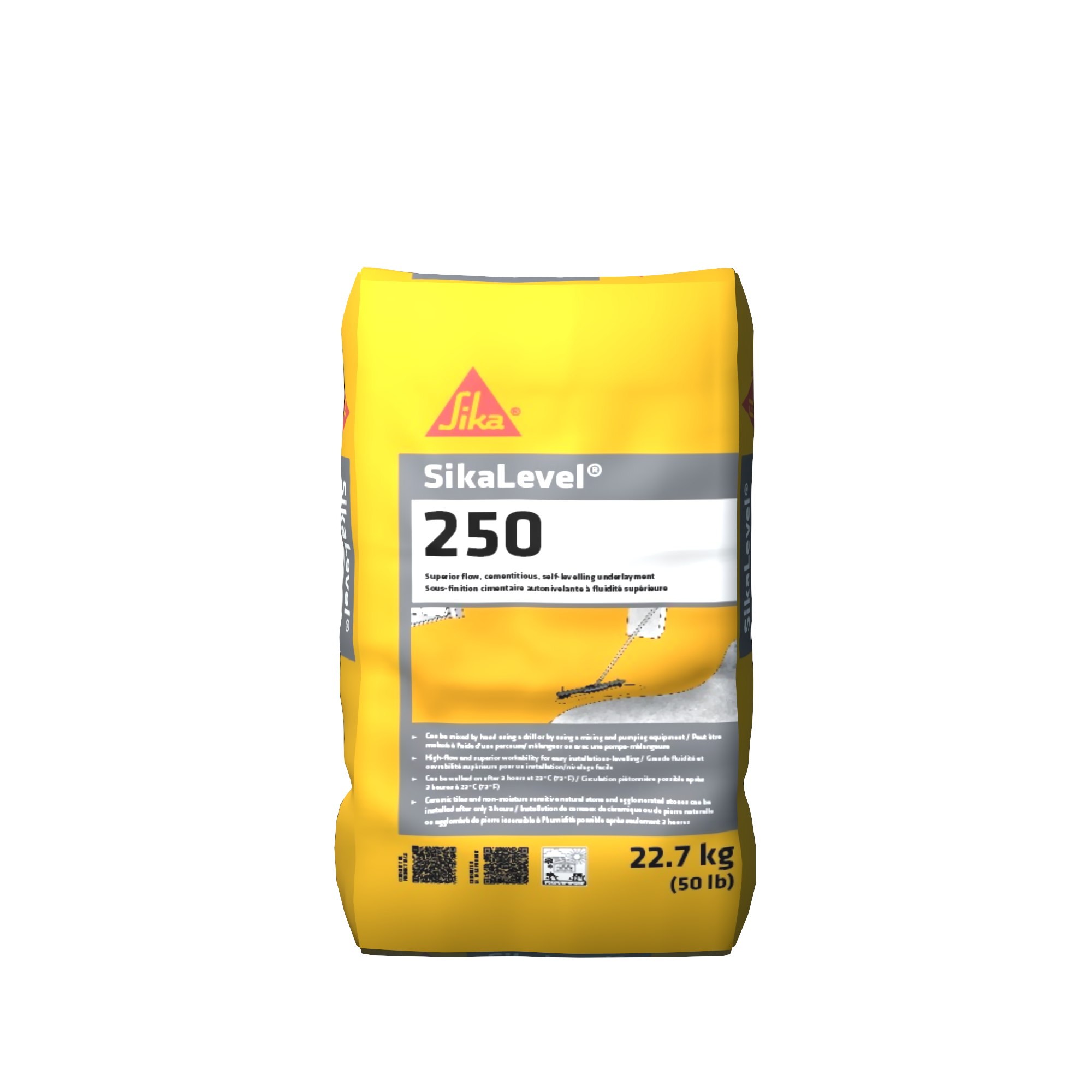
SikaLevel®-250
SikaLevel®-250 is a one-component, polymermodified cementitious underlayment for interior concrete, engineer-approved plywood and a variety of existing substrates. Its high-flow, self-leveling properties allow it to be applied, either manually or by pump, to produce a flat and cost-effective substrate prior to the application of a final floor finish. Typical application thickness is 3–31 mm (1/8–1 1/4 in).
- Hgh-flow fluidity and superior workability for easy installation-leveling
- Zero VOC content and low odour
- Can be mixed using a drill or by using a mixing and pumping equipment (see Pump Mixing section)
- Levels new and renovates old floors
- Can be walked on after 3 hours at 23 °C
- Ceramic tiles and non-moisture sensitive natural stone and agglomerated stones can be installed after only 3 hours
- Carpet can be installed after only 16 hours. Vinyl and PVC flooring can be installed after 1 day. Rubber and engineered wood flooring can be installed after 3 days
- Suitable on floors with in-floor radiant heating
Usage
- Concrete
- Approved plywood underlayment
- Poured gypsum based underlayment and poured "hybrid" (gypsum/cement based) underlayment
- Unconventional substrates with SikaLevel®-02 EZ Primer CA (see product data sheet for more information)
- SikaLevel®-250 can serve as a underlayment to receive our Sikafloor®-261 CA or Sikafloor®-219 UTE epoxy floor coatings 1 and 2
- Floor heating system (heating cables or uncoupling membrane with heating cables) 3
Advantages
- Hgh-flow fluidity and superior workability for easy installation-leveling
- Zero VOC content and low odour
- Can be mixed using a drill or by using a mixing and pumping equipment (see Pump Mixing section)
- Levels new and renovates old floors
- Can be walked on after 3 hours at 23 °C
- Ceramic tiles and non-moisture sensitive natural stone and agglomerated stones can be installed after only 3 hours
- Carpet can be installed after only 16 hours. Vinyl and PVC flooring can be installed after 1 day. Rubber and engineered wood flooring can be installed after 3 days
- Suitable on floors with in-floor radiant heating
Packaging
22.7 kg (50 lb) bag
Product Details
Composition / Manufacturing
Cement-based, fillers and Sika’s latest generation of polymers
Shelf Life
12 months in original, unopened bag.
Storage Conditions
Stored (unopened) in its original packaging, in a dry place between 5 °C (41 °F) and 32 °C (90 °F). For best results, condition product between 18 °C (65 °F) and 29 °C (84 °F) before using.
Density
| 2.1 kg/L (132 lb/ft3) (wet mix) | (ASTM C185) |
Compressive Strength
| 24 hours | 20 MPa (3045 psi) |
| 7 days | 30 MPa (4351 psi) |
| 28 days | 34.9 MPa (5061 psi) |
Tensile Strength in Flexure
| 7 days | 6.7 MPa (972 psi) |
Tensile Strength
> 2 MPa (290 psi) failure in the substrate
Application
Mixing Ratio
Between 4.75 L and 5 L (1.25 and 1.32 US gal.) water per 22.7 kg (50 lb) bag
Ambient Air Temperature
Between 5 °C (41 °F) and 35 °C (95 °F)
Relative Air Humidity
< 75 %
Note: The substrate and uncured product applied on the floor, must be at least 3 °C above dew point to reduce the risk of condensation, blooming or cement laitance forming on the surface.
Substrate Temperature
Between 13 °C (55 °F) and 32 °C (90 °F)
Waiting Time
Can be walked on after 3 hours
Floor covering installation:
- Ceramic tile and moisture-insensitive stone: 3 hours
- All other floor coverings: Between 16 hours and 3 days depending on the type of floor covering.
Note: The above data is provided as an indication, for a temperature of 23 °C (73 °F) and ambient relative humidity of 50 % when applied at 9 mm (3/8 in). Drying will be affected by the actual job site conditions (such as temperature and relative humidity in particular). Prior to the installation of the SikaLevel®-250 system, the moisture level in the concrete slab must be measured following the written instructions and meet the requirements of the manufacturer of the floor covering to be installed.
Flowability
SikaLevel®-250 provides up to 20 minutes of working time.
Yield
~15.3 L (4 US gal.) per 22.7 kg (50 lb) bag
Approximate coverage at typical thicknesses per 22.7 kg (50 lb) bag:
▪ 6 mm (1/4 in) 2.4 m2 (26 ft2)
▪ 12 mm (1/2 in) 1.2 m2 (13 ft2)
Note: Coverage figures do not include allowance for surface profile and porosity or material waste.
SUBSTRATE QUALITY
Concrete substrates must be structurally sound and solid. Compressive strength must be at least 25 MPa (3625 psi) and tensile strength a minimum of 1.5 MPa (218 psi) at the time of application of the SikaLevel®-250.
Plywood Substrates (for residential interior flooring in dry areas only)
When applying SikaLevel®-250to plywood substrates. The appropriate subfloor (immediately above the joists) must be a Douglas fir plywood (CSA 0121), Canadian softwood plywood (CSA 0151), poplar plywood (CSA 0153) construction sheathing, or APA Sturd-I-Floor OSB, Exposure 1, with a minimum thickness of 16 mm (5/8 in.). The joists must be spaced 406 mm (16 in) on center. The ends of the subfloor sheets must be spaced 3 mm (1/8 in) apart. The subfloor must be fastened with 30 mm (1 3/16 in) screws placed 150 mm (6 in) on center around the perimeter and 200 mm (8 in) on center across the entire body of the panel. All ends and edges of the panels must be supported by a framing element.
The appropriate underlayment (on the subfloor) should be Group 1 exterior plywood at least 12 mm (1/2 in) thick, CANPLY Select (SEL) or Select Tight Face (SEL TF) plywood conforming to CSA-0121 for Douglas Fir (DFP) for direct-glue applications. Before purchasing or ordering plywood, note that certification information (such as the CSA standard) is usually found on the underside of the plywood. Note: The wood flooring must meet at least L/360 deflection parameters, taking into account both static loads, such as kitchen islands, and dynamic loads. Refer to the final flooring manufacturer for the flooring system's deflection requirements, as more stringent criteria may apply to arge-format tiles or stone products. For example, for stone, the maximum allowable deflection is L/720 (which requires the substrate to be twice as rigid) and may necessitate a thicker subfloor and underlayment.
Offset the underlayment joints relative to the subfloor joints and stagger the joints between the sheet ends. The underlayment must be fastened with 30 mm (1 3/16 in) screws spaced 150 mm (6 in) center to center around the perimeter and 200 mm (8 in) in center, through the entire panel. The underlayment screws must pass through the full thickness of the assembly but must not penetrate the joists or cross bracing/solid blocking. The edges of the underlayment sheet must be set back 6 mm (1/4 in) from all adjacent surfaces (walls, countertops, etc.)
MIXING
Use between 4.75 L and 5 L (1.25 and 1.32 US gal.) of potable water [~ 21 °C (~70 °F)] for each 22.7 kg bag of SikaLevel®-250.
Manual mixing
Pour the appropriate amount of water into a suitably sized and clean mixing container, using a calibrated measuring jug, or similar, to ensure strict control of the water content (do not add more water). Add SikaLevel®-250 to the water, while slowly mixing, adding the complete contents of the bag. If available water is not at this temperature, then consideration should be given to cooling/heating the water. Mix with a high-speed drill (> 650 rpm) and an egg beater style mixing paddle to blend water and powder for approximately three (3) minutes, until a lump-free and uniform mix has been produced. Do not overmix or allow the paddle to rise above the level of material as this will introduce and entrap air into the mix, potentially shortening the working life or causing pin-holing at the surface of SikaLevel®-250.
Pump mixing
Pump mixing can save time over manual mixing. Best industry practice will ensure proper performance of any self-leveling material and Sika wishes to share some important ones with you:
- SikaLevel®-250 can be mechanically mixed with a continuous mixer and pump using a minimum of 40 m (130 ft) of hose and a maximum of 65 m (215 ft), or with a batch mixer and pump using a minimum of 25 m (80 ft) of hose and a maximum of 40 m (130 ft). Some mixing occurs as the material travels through the hose but minimum length is critical to ensure proper consistency and lump-free material is delivered. Furthermore, when using a batch mixer, do not cut short on the mixing time (to ensure a homogeneous mix, prevent segregation, etc.).
- Consideration should be given about how the hose is held at delivery (above the shoulder). This will help provide some back pressure in the hose which can generally improve the consistency at delivery.
- Verify flow periodically (at least for each skid of selfleveling material).
- Ensure that water pressure/output to the mixing equipment is fairly consistent. Variation of water pressure at source will impact on the consistency of SikaLevel®-250. Do not exceed water ratio. The consistency and flow time will seem better but this will invite segregation which results in increase shrinkage (crack development) and weak/soft surface).
APPLICATION
Pour the mix and spread using a smoothing trowel. Even surfaces are easily achieved using a pin leveler. It’s not recommended to remove trowelling defects or to level more than once. SikaLevel®-250 has an approximate self-healing (working) time of up to 20 minutes at 23 °C (73 °F). SikaLevel®-250 can be applied from 3 mm to 30 mm (1/8 in to 1 1/4 in) in a single application. Apply enough SikaLevel®-250 to sufficiently cover all high spots. Smooth the surface with a smoother tool to obtain an even surface. Consider the width of the pour so as to maintaining a wet edge throughout placement. If a second layer of leveling compound has to be applied, prime the first layer with Sikalevel®-03 Primer Plus (1:1) when the first layer is walkable. The second layer must not exceed the layer thickness of the first layer. Protect curing SikaLevel®-250 from high ambient temperatures, direct sunlight and drafts.
For application regarding Sikafloor®-261 CA or Sikafloor®-219 UTE coatings
1. Light traffic areas (offices, lobbies, etc.): Apply the [SikaLevel®-250 ensuring a thickness of at least 3 mm (1/8 in) above the highest point of the prepared substrate.
2. Moderate traffic areas and areas exposed to rubber/polyurethane wheeled cart traffic (commercial and institutional spaces, hospitals, etc.): Apply the SikaLevel®-250 ensuring a thickness of at least 6 mm (1/4 in) above the highest point of the prepared substrate.
3. High-traffic areas and areas exposed to occasional pallet jack traffic with hard rubber or polyurethane wheels (shopping malls, stores, airport terminals, work areas, laboratories, car dealership showrooms, etc.): Pour the SikaLevel®-250 ensuring a thickness of at least 9 mm (3/8 in) above the highest point of the prepared substrate.
Note:
1. Understand that the minimum thickness is necessary to ensure proper transfer of static and dynamic loads through the flooring system to prevent the SikaLevel®-250 coating from chipping.
2. Once the selected coating has been applied and sufficiently cured. To avoid premature wear of the two (2) Sikafloor® coatings mentioned above, ensure at all times that the wheels (such as, but not limited to trolleys and/or pallet trucks) are free of abrasive contaminants or nails/screws/bolts.
Note: Jobsite trials (while considering possibly also including the floor covering) are recommended to establish suitability of application equipment and technique, acceptable workmanship, consumption and coverage rates and the performance of the floor system as a whole.
CURING TREATMENT
SikaLevel®-250 must be allowed to air cure. Do not wet cure or use curing and sealing compounds.
CLEAN UP
Clean all tools and application equipment with water immediately after use. Hardened / cured material can only be removed mechanically.
